


Singapore American School (SAS) has introduced an updated math pathway. This shift reflects a strategic move towards an integrated curriculum, aligning with the school’s goal to offer a cohesive and accessible approach to mathematics. The updated pathway aims to support students’ academic growth and individual math goals while reducing the need for summer courses or validation exams. Here’s a closer look at what this new pathway involves, along with insights into how it may affect students’ learning experiences.
The New Integrated Math Pathway: An Overview
The new pathway at SAS transitions away from the traditional sequence of Algebra I, Geometry, and Algebra II/Trigonometry, opting instead for integrated math courses. This change offers students a more interconnected view of mathematical concepts, incorporating algebraic, statistics, geometric, and trigonometric ideas across different levels in a structured sequence. The program uses the Illustrative Math curriculum, ensuring alignment with Common Core standards and SAS’s emphasis on problem-based learning.
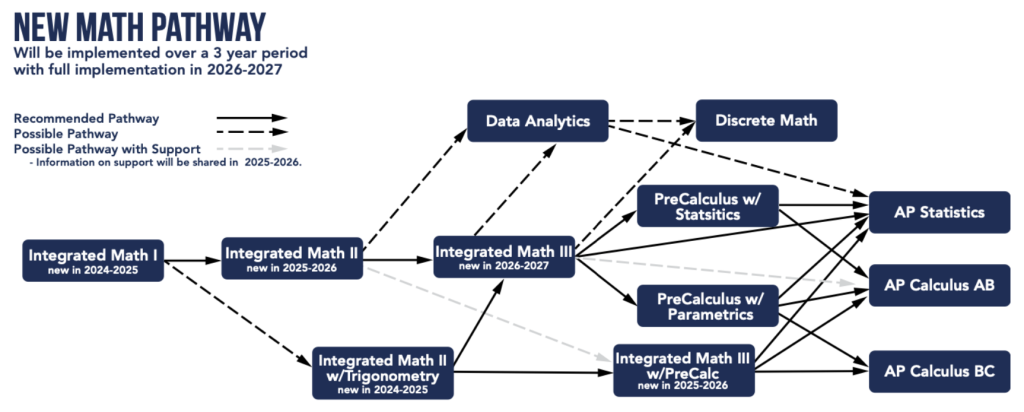
Over the next three years, SAS will phase in these integrated courses. The new sequence includes Integrated Math I, followed by Integrated Math II, and then Integrated Math III. During the transition period, students who began the previous pathway will continue with Algebra, Geometry, and Trigonometry as originally planned.
During this transition, students in the classes of 2025 to 2028 who have started on the previous pathway will continue their courses in Algebra, Geometry, and Trigonometry as planned.
Breaking Down the Integrated Math Sequence
The new sequence is designed to deepen students’ mathematical understanding progressively. Here’s a breakdown of what each integrated course will cover:
The primary sequence in the new SAS math pathway progresses through Integrated Math I, Integrated Math II, and Integrated Math III. Some students may take Integrated Math II with Trigonometry in place of the standard Integrated Math II course, depending on their readiness and interest.
For students demonstrating strong mathematical foundations, supported accelerated pathways are available. One option allows students to move directly from Integrated Math II into Integrated Math III with Precalculus, positioning them to take AP Calculus AB/BC the following year. Another accelerated path enables students to bypass Precalculus entirely, progressing from Integrated Math III directly into AP Calculus AB.
After completing either Integrated Math II or III, students may choose to explore a Data Analytics course, which builds a strong foundation for AP Statistics. Students completing Integrated Math III with Trigonometry are prepared to enter Precalculus, which is designed to lead directly into AP Calculus AB or BC courses.
How the New Pathway Enhances Learning
- Strengthened Foundation:
By integrating various mathematical disciplines, the pathway reinforces concepts across algebra, geometry, and trigonometry, making it easier for students to see the connections between topics. This holistic approach is expected to improve retention and understanding. - Increased Flexibility:
SAS aims to make transitions between levels smoother, supporting students in accessing advanced courses without validation exams or additional summer courses. The pathway is structured so that students who demonstrate proficiency in essential skills can move forward confidently. - Greater Emphasis on Applied Math:
The inclusion of topics like data analysis, probability in Integrated Math III reflects a trend towards practical, applied mathematics. This focus aligns with college readiness, providing skills relevant for fields that rely on data and analytics.
Addressing Challenges and Areas of Uncertainty
- Algebra-Intensive Coursework:
The integrated approach requires solid algebra skills. Students with weaker algebra foundations may need additional support. - Applications of Trigonometry:
Integrated Math II with Trigonometry introduces trigonometric functions and radians in a way that may be unfamiliar to some students. Teachers and tutors will likely focus on building students’ comfort with these concepts through practical problem-solving. - Accelerated Track Challenges:
The accelerated pathway may feel intense for some students, as it condenses the curriculum into a shorter timeframe. Students moving from Integrated Math I directly into Integrated Math II with Trigonometry will need to be prepared for a rigorous pace.

Preparing for Success in the New Math Pathway
- Focus on Conceptual Understanding:
The pathway seems to be designed to showcase the connections in mathematics and different applications of the learnt concepts. Rather than memorising formulas, students should prioritise understanding the relationships between algebraic, geometric, and trigonometric concepts. Tutors and teachers can assist by providing context and real-world examples. - Stay Consistent with Practice:
Frequent practice is essential, particularly with algebra and trigonometry, as these form the foundation of much of the curriculum. Students who consistently engage with the material are more likely to excel. - Leverage Khan Academy Resources:
Khan Academy assignments provide helpful exercises that align closely with the integrated math curriculum.
The new math pathway at SAS reflects an innovative approach to high school math education. By offering a flexible, integrated structure, SAS has created a system that supports a variety of learning paces while maintaining a strong focus on foundational math skills. As the pathway rolls out over the next few years, students can look forward to a curriculum that is both challenging and adaptive, equipping them with the skills needed for college and beyond.
Disclaimer: This article is not affiliated with, endorsed by, or approved by Singapore American School. SAS does not authorize the use of its name, imagery, or curriculum for promotional purposes by external parties, and does not endorse any tuition providers.
AP Trial Lesson Registration
Unsure if Prep Zone’s 1-to-1 AP tuition program is for you? Sign-up for a trial session today and experience the Prep Zone difference.
For any urgent inquiries, contact us at +65 6812 9999 or Whatsapp us at +65 8305 1871
By submitting this form, I agree to Prep Zone Academy’s Privacy Policy and Terms of Use.

